Thursday, October 3, 2019

The Importance of Co-Curricular Involvement at School

I believe that co-curricular involvement at school is just as important as the formal curriculum itself.  For the record, I am talking about all forms of co-curricular involvement, not just sports.  If anything, I would hope this type of article encourages the reader to realize that non-sports activities need to be more of a priority at schools and with parents.

Personally, I consider myself an enthusiastic evangelist for co-curricular activity for students and support for these activities by faculty and staff.  I believe in it and I live it.

Back in the day, it was known as extra-curricular.  As time passed a new term was introduced "co-curricular" to imply that it was more tied to the curriculum and extra-curricular was more of a school facilitated activity, but not tied to academic learning (ie sports). The term co-curricular has evolved to encompass all school facilitated activities.

During my youth, my entire family was involved in extra-curricular activities at school, via sports, student government and other activities.  A little older now (just a little) I am happy that my children and nephews were very involved in elementary and high school outside the classroom and not just with sports.  Some of my cousins coach in their respective high schools in both Canada and the USA and that makes me very proud.

Why is co-curricular important to so many people and why do schools invest taxpayer funded resources in such activities? Notice I wrote invest and not spend.

In my opinion, school must be a place where people WANT to go everyday and feel like a true part of the learning community. 

Co-curricular activities engage students in activities that are outside the formal learning environments.  At the elementary and high school levels, students are able to meet schoolmates who might not be in their classes and get to know teachers in a different setting.  Teachers can also see their students in a different light and see what drives them.

I believe that the school itself is its own entity that facilitates teaching and learning and co-curricular involvement deepens the relationship with the school itself and others in the school.  All of this, I submit, strengthens the commitment to education and lowers barriers to some challenges a student may face.

At the post-secondary level, I feel co-curricular is just as important, if not more.  Traditionally, college and universities are much bigger than high schools and possibly have the impression of a more faceless environment.  Being a member of a college faculty and having attended college and university, I reject that assumption and know there is a personal experience waiting for everybody, but you have to step forward.

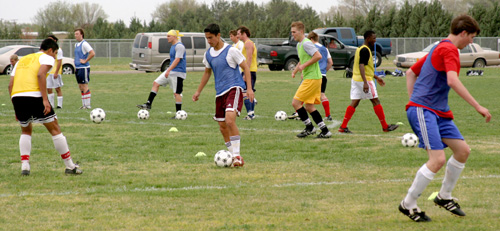
I teach Technology at Niagara College, coach the men's varsity soccer team and am taking over the HAM radio club this year.  The retiring professor was passionate about finding somebody to keep these groups moving forward and he actually inspired me to write this article.  This man was very involved in sports as were his children and he devoted his time to this club.  In addition to varsity sports, Niagara College has many clubs and events for students as do many colleges and universities.  If sports are your thing, but not at the varsity level, every college and university has intramural leagues.

Getting involved at school doesn't always have to be a formal organized event with staff and rules.   You can go to the school's fitness centre, open gym time etc.  You (and maybe some classmates) can volunteer your time in the community towards something that you feel passionate about.   At Niagara College there are a group of students who are into gaming who congregate in one area of the student centre. No staff, no rules, no constitution or bylaws... just student having fun and socializing outside of class.

One advantage of formalized activities is that they sometimes have academic standards tied to their involvement, hopefully motivating an apathetic student who is passionate about the activity. At the OCAA and OUA level, academic eligibility must be maintained to stay eligible to play.  In most high school sports, if you skip a class the day of a game or activity you cannot participate that day.

If your child is not involved in anything at school, you may want to encourage participation and help them research what they might enjoy.  When my sons were in university I was always asking about what they were doing outside of the class.  They know why and I was never disappointed with the answer.

One of my main points that I want to stress again is that it does not need to be a sport.  Regardless of what people say, sports are not as important to many school age students and I feel like they are becoming less important every day.  Camera club, cooking, social justice, LGBTQ, environment, school band, student government, politics, gaming clubs, drama, robotics, peer tutoring, computers, horticulture, etc.

If you think a student wants to be involved but none of your offerings appeal to them, ask them what does appeal to them and figure something out.  Give them a place to shine and stand back.

Some of my pet peeves with organized co-curricular activities:
  • Lack of faculty/staff support in terms of academic flexibility to allow involvement if it involves representing your school off campus.  If a student is up-to-date with submissions and attendance, there is no reason to block participation, unless your class is writing the entrance exam for Harvard Medical School 😏
  • Lack of recognition for non-sport activities, both publicly and during times of budget planning.
  • Absence of links that tie participation in any formal activities to attendance and behaviour in class. 
  • Occasional lack of parental support for non-sport activities.  If your child is in a non-sport activity, you get your buns over there like you would a football or basketball championship.
  • Non-sport activities being bumped or ignored to support sports based activities.
  • Disproportionate resources assigned to sports over non-sport activities.
  • Lack of proper promotion for non-sports activities.
  • High schools' lack of formally recognizing a teacher's involvement in leading co-curriculuar activities.  In some areas of the United States, a teacher's pay is affected by their co-curricular involvement.   
  • Not all teachers/faculty/staff are suited, comfortable or interested in facilitating a co-curricular activity and should have their wishes respected.  They can still be supportive of those who do and that's still a good thing. 
  • The mountain of rules that impede outside individuals from helping to enhance a school's program offering is ridiculous.
  • External facilitators of activities who believe their program is better than the school's and discourage school involvement.  (For the record... I believe professional/national/provincial programs have that right to do so, for injury and load management reasons.)
Some of my perceived benefits of co-curricular involvement:
  • Cultural integration into new school setting
  • Social skills
  • Possibly help with homesickness for students
  • Build your resume or portfolio
  • Time management skills
  • Gain new skills
  • Leads for future employment
  • Familiar faces make the hallway less intimidating for some
  • Keep kids busy (for those that believe that idle hands do the devil's work)
One of my favourite co-curricular story over the past 12 months: Jenna Wilson, our Recreation Coordinator at Niagara College, organized a Star Wars based activity at the college last year.  The theme was how to properly handle a light sabre.  Under the guidance of Mark Kawabe of the Niagara Kendo Club, students were shown how to handle their "weapon" and the body movements involved.  It was a smash hit with the students involved and generated a lot of onlookers from outside the gym.   
I also want to recognize Aesthetics teacher Dee Laalo at Notre Dame College School in Welland who started a drumline corps at school that has been a smash hit.

My goal before retirement is to start a club for students who want to be able to run an organized 5km run for the first time, a couch-to-5k kinda club.  Not a race or competition, but to get themselves to the point where they can run 5km.  It would involve medical supervision, support for lifestyle changes and other supports.

Let me leave you with this: I believe students who are involved outside the classroom are now part of the school community in a bigger way and develop a deeper sense of ownership of the school community and their own student experience and academic achievement.

Additional Reading: Chicago Tribune - Participation in student activities linked to academic success


Tuesday, March 5, 2019

You Say Your Players Aren't Listening? You Might Not Like This.


Coaches are always asking about discipline and remedies for when their youth players aren't
listening.  The question is usually asked with the mindset that the players are to blame.

Before I answer, I take a deep breath, assess how much I value that coach's friendship, predict possible reactions, then deliver my answer in my usual pleasant and positive disposition: 95% of the time it's YOU.  Maybe 96%.

OK, let me rephrase that in a more productive tone and manner.

I offer this one bit of advice that I find helpful: blame the players LAST. This forces you to examine as many possibilities as possible and forces you to reflect on your session. (This is a good time for an "It's not you, it's me" reference)

Tuesday, February 19, 2019

The Importance of Using Jargon-Free and Slang-Free Language When You Coach

Plain English please! (or whatever language you coach in)

"You're damned if you do and you're damned if you don't."

"You're burning your candle at both ends."

"It's boiling out", "do that ASAP"

Think about these sayings. Who would know them and at what age would they have understood their meaning?  Your job as a coach is to make yourself understood so you can transfer your knowledge to your players.

Let's discuss the age of understanding jargon and slang.

Wednesday, February 6, 2019

The Difference Between Treating Players Equally and Fairly.

If you know who I should credit for this cartoon, please email me. Thanks.
Do you know the difference between treating players equally and fairly?  There is a huge difference. How we treat different players is influenced by so many things including our perception of what some people refer to as "attitude".

Aren't we supposed to treat everybody 100% equally?  Can we? Should we? Are there standards for everybody to keep?

The first problem is coaches aren't sure what to do and do not have a lot of experience dealing with a variety of personalities looking to them for guidance.  They are usually volunteers in a pay-to-play system. (The pay-to-play model complicates things way more than people appreciate.)

Friday, November 16, 2018

Proof: Over-coaching from the bench is illogical.

So you like to control your players from the sideline, eh?

If the theoretical, anecdotal and experience arguments don't sway you away from over-coaching during games, let's look at it from a logical standpoint.  Scaling back your desire or need to over-coach from the touchline is no easy task, but it's something you need to aspire to.

Enough has been written about why you shouldn't over-coach and those articles revolve around a player's freedom of expression, developing decision making, increasing Soccer IQ, joie de vivre, etc.  Those arguments aren't backed up with facts or measurable quantities.  If you aren't buying those arguments, let me attack it from another angle.


Wednesday, May 2, 2018

It's time to cut your BEST player

Now that I have your attention 👊

With the recent passing of Dick Bate, I was reminded of something he said to us while he was still in Canada, as the CSA Technical Director:

"The best coaches lose their best players."

In February 2006, we had Coach Bate visit the Welland Soccer Club for an on-field and classroom session.  He opened his talk with that line and the room was overcome with a thundering, earth-shattering silence.

The concept was revolutionary for many, but for a few it's something that has frustrated us for years.  At the time, as the club's technical director, I was in a battle-royale with a club coach over a player.  The player was very good, the current coach was weak and the team played in a lower league.  We had no viable in-club option to serve her.  She was on her way to a better team, in a better league with a better coach and I was being asked by their coach to call her parents to advise them (ie. mislead) that they were making a mistake.  His beef was that it would hurt his team and he would lose more players.  My argument was that it was best for the player and it would give another player on his team a chance to move up and be "the best player".

Why would you ever hold a player back if they have outgrown you or your situation?  Once the thought has entered somebody's mind, it may as well be dealt with because the relationship is about to be tested.

A different situation could be a better/different league or a better coach.  To me, the deal must include moving to a better coach to make it legitimate, but sometimes being in a better league with a competent coach will help the kid.  (nb. a higher league does not always equal better soccer.)

We all need to remember something very important; we do NOT own the player.

In my own experiences I have witnessed:

  • Ontario coaches trying to keep their players away from Toronto FC Academy when it was first organized. (I list this first because it shocked me the most)
  • Up until 2015, U14 coaches who did not qualify for OYSL work to keep their players away from the teams that did qualify and did have a competent coach at the helm.  
  • In Niagara, local coaches working to keep players away from the Regional program that their own presidents voted into existence. In four instances, it was coaches who supported the program until they were not chosen to coach a regional team.
  • As coach of the Niagara U12 District program for 4 years, some coaches told me they did not want their players to come out for fear of them being recruited by other coaches. At the time, the District program was the fist step in the Regional/Provincial program. 
  • Coaches that would not agree to let their players play for the club team above them, as a call up.  Whether it's B team to A team or playing a year up.  We reminded them that they did not have that authority.

The best player on every team has not necessarily outgrown their situation, but there are instances where this is clearly the case.  This is where the Technical Director needs to start the conversation. From a club perspective, an ideal solution has the player play for the same club.

Some possible scenarios for expanding your best player's experiences:

  • Arrange attendance at training sessions with a higher level team/coach.
  • Arrange maximum call-ups to the next highest team at your club.
  • Arrange maximum call-ups to a higher team at another club.
  • Arrange a guest-player scenario for another team at a tournament.
  • If the player agrees and a competent coach is present, move them to the next highest team at your club. If this is not available, then another team at another club.

There are two possible outcomes if you offer to expose your better players to another situation: they will accept or they will decline.  Either way, all of your players will know you have their best interests at heart and that's a big deal.

I have been coaching with the same gentleman since 1988 and we have both always judged ourselves by how well our players do away from our program. Its a nice feeling to see them doing well.

Reaffirming my obsession/frustration with coaches who impede a player's progress was Dick Bate's gift to me and I am forever thankful.

Rest in Peace, Coach.

Endnotes.

The young lady at the heart of my battle-royale mentioned earlier recently completed a 4-year degree on a Division 1 NCAA scholarship in Alabama.  The young lady who became the next "best player" after the departure also just completed a 4-year scholarship at a NCAA school.

I have seen players move to teams that were in lower divisions but coached by more qualified and better coaches.  Again, the coach.

Holy moly, I just looked. I haven't posted an article in almost two years.


Tuesday, June 14, 2016

Are you TRULY in tune with the tryout process?

You were awarded the team and your first advertisement goes out.  "TRYOUTS.  Wednesday, 6:00-8:00pm Blah Blah Blah"

Chances are, if you're reading this, you coach an amateur team that belongs to a club or educational institution.

Nobody has the tryout process mastered and we've all made mistakes that we wish we could take back.  We try to conduct them as professionally as possible, but nobody has it mastered.

What is your job during tryouts? What is appropriate for the age you are coaching? (If you are coaching U12 and below, are tryouts appropriate at all?)

You're thinking this might be a guide on how to select players, but it's just as much about the players you don't select and the environment you've set up at tryouts.

I am fortunate that I have a very enjoyable coaching situation with the Niagara College Men's and Women's Soccer programs.  I am surrounded and supported by good people and I like to think we look at the tryout process in a bigger scope, outside of soccer.

On a quantitative level, our job is to select the 22-24 student-athletes who we feel will achieve the best possible results and challenge for a national championship. There is much more going on.
Nobody has the tryout process mastered and we've all made mistakes that we wish we could take back. 
We are in a different position than basketball and volleyball.  Their student-athletes have a chance to acclimatize to the campus environment and fall into a bit of a routine before their athletic schedules ramp up to their full commitment.  The first-year players who are in our program are figuring out their academic life while the soccer program is in in full motion, with some living away from home at the first time.


What do you need to keep in mind during your tryouts in your particular coaching situation?
This is what we need to consider during tryouts for our college program:
  • Recruiting begins early, many times when the prospective player is in Grade 11.  Are we giving them a positive image of Niagara College, and post secondary education in general?  We have the ability to get them excited about the next phase of their education. (Is your club's travel program making a positive impression that seeps its way down to the younger age groups?)
  • Varsity Soccer tryouts begin August 14, a full 26 days before the fall semester starts.  Do our new students and prospective athletes receive a positive impression of the college they've chosen?  If their parents drop them off, what will be their impression?
  • Is the organization and delivery on Day 1 consistent with the experience that Niagara College wants their new students to encounter?
  • Is the selection process laid out for them?  Is the Day 1 experience at soccer a sneak peak at their first days of class when professors review their Course Outline and Teaching and Learning Plans  for their selected courses in their respective programs?
  • Do they know what's expected of them, physically? Are they aware of the commitment and expectations? 
  • Niagara College is a diverse learning community and our tryouts reflect that in every way.  We welcome the athletes, share our passion for the game and our enjoyment of the situation, but we don't use jargon, clichés or make parochial comments to ensure the environment is inclusive and welcoming.  Not only is it respectful and properly reflects Canada, it also helps more players bring out their best and puts us in a better position to select the strongest team.
  • Can we answer more immediate questions for them about the college and details they need to tend to before classes begin?  During tryouts we receive questions regarding registration, financial aid, bookstore hours, local amenities, etc.  
In case you haven't noticed .. we haven't even touched the ball yet.
  • Is the process fair and does it provide players with a true opportunity to showcase their skills?  Not only does this respect the player, again,  it gives us a better chance of selecting the best players.
  • How do we deal with the players who aren't selected along the way? Some players have moved into their new living arrangements early and may end up being in Welland for a few weeks before classes begin.  Many go home and return for classes, but a few remain in the city.
  • Did we create a positive enough experience that the players who weren't selected still wish to seek out an active lifestyle in their new college environment? Being released from tryouts is a difficult life event, but handled correctly the player will find other avenues to stay active.
  • For the players who are selected, have we provided enough guidance and support that the beginning of the semester is a positive experience, not an avalanche of new commitments.
Niagara College has trusted us to deal with almost one hundred of their students before the semester begins and we know their expectations.  The situation is interesting because this will be the last occasion in most of these players' lives where they will face a tryout process.  For many of the selected players, it will also be the last time where they will compete for playing time.

That is our spectrum of considerations every August.  What does your club expect of you?  Do the players you released continue playing or do they quit after the selection process?  Will they stay at your club and try out again next year?

How you conduct the process and treat the players you release speaks volumes of who you are and
An example of a tryout ad.  I have no idea who this club is.
lays the foundation for a positive team environment.  In my situation, I encounter many of the students we did not select around campus and it's important to me that we continue to have a good rapport throughout the academic year.  It's important for the players we select to know that the players we didn't select were handled fairly.

Some ideas for your tryouts:

  • Do the players understand what you're looking for?  If you can't spell it out and share it, how will you know if you see it.  Sometimes a coach will tell a player "You didn't have what we were looking for."  and the player is wondering "What were you looking for?"
  • Learn their names.  We have a lot of players attending and take everybody's picture with them holding their name on a small whiteboard, resembling a mug shot.  I had a released player tell me once that I didn't know who he was.  When my assistant and I told him what he was wearing the past few days, where he was playing and some of the on-field scenarios we remember, he dropped the accusation.
  • Be ready and organized!  Get the tryout sessions going quickly so the players can show their stuff.  Long speeches at tryouts are just long speeches, nothing else.  They came to impress you, not vice verse.
  • Give players a fair chance to showcase their skills.  Often, if they're realistic, they will know the outcome before you tell them.  In a situation where there are a lot of players, not everybody will have a chance to play in a game, but there are still ways to have a game situation. A good friend is a scout for the Boston Bruins and he said once that players will cut themselves if tryouts give them enough chances to play.  I never forgot that.
  • My pet peeve is signing players along the way until you have two or three players battling for one or two spots - you've pretty much just told those kids they are the weakest on your team and you've set up a pecking order from day one. If you do implement that method, do so at your own risk and don't email me for advice because you will not like my answer.
  • If you are releasing a player, give them some information so they can move forward.  In a youth club environment, a list of contacts for other playing situations would be very helpful to them and their parents.
My final point for you to consider is how quickly news spreads in 2016.  Whether you inform the selected or released players first will not affect how quickly the telephone and social media inferno ignites and players start to figure out the team on their own.  The news should come from you, not from somebody else's Facebook status.

The specific process you implement will depend on numbers, schedule, facility availability etc.

Remember what your tryouts are; a group of ambitious, enthusiastic athletes who want to show you that they have the skills to be selected to the program you are running.  Their willingness to be judged and evaluated obliges you to give them the respect they deserve and nothing less.

Just remember to run a tryout process that you would feel comfortable with if you or your child were trying out for a team.


Monday, March 14, 2016

The importance of being yourself when you coach.

be yourself
In any activity where you are the leader in a situation such as coaching or teaching, a major part of your apprenticeship is being encouraged to "be yourself".

Sounds easy, doesn't it?

BE.  YOURSELF.  Ya, simple.

Since 1988, I have been coaching non-stop and have done a lot of teaching.  I even had a stint in politics.  Even with all that exposure, the "be yourself" thing took a while to happen.

Learning how to be yourself is a major part of your development in any profession or pursuit, including coaching.

Why is it so important to be yourself?  Well, the first reason is that you are beautiful.  You must be

Tuesday, March 1, 2016

The Danger of Consolidating Players Before U12

"The best players need to play together."  Do they?  Maybe, but when?

Let me offer some disclosure so you know my mind set.  I am not a fan of recruiting.

For your personal trophy case and perhaps your coaching resumé, consolidating the best players in your area as soon as possible might seem like a good idea.

For the development of the age group, I think early consolidation is damaging to everybody involved including the players who are being consolidated.

In many cases, consolidating players before their U12 year does nothing for anybody other than their coach. Not all cases, but many.

A coach has a decent U8 team.  He sees his friend has a son on a neighbouring town's team and the boy is decent.  "Hmm...." he thinks to himself and when the season ends, he invites his pal over for a

Thursday, February 4, 2016

We Need to Show our Players How to Reflect

soccer reflection
"Reflection".  Sounds great, but do our players know how to reflect? Have you shown them how?

My coaching pal Chris Loucks brings this up on occasion and he got me thinking.

As you move up in your coaching education, reflection becomes a major part of the process.   Having also attended Teacher's College, I've been through the reflection process many times.

As adults we start to appreciate the benefits of reflecting and we make good use of what we learn from it.

The frustration for some is when you ask your players to reflect and they look at you with a blank face.  You may not remember this during your certification process, but somebody along the way did teach you how to reflect.  I wrote about reflecting way back in 2012.

Don't you think we need to teach our players how to reflect?

Thursday, January 28, 2016

Coaches, Always Keep Your Ears Open a.k.a. What I Learned in Church.

coaching soccer team work
On Sunday,  January 24, I attended 9:00am mass at St Francis Xavier Church in Brockville, ON.

Before I get started here, I need to say the church building itself was absolutely amazing, inside and outside.

My ears are always open, no matter where I am.  Maybe I'm nosey, maybe, but I am always listening. A coach's eyes and ears should always be open.  There is always something to learn and if you are not receptive, you might miss something big.

During that mass in Brockville, the lay reader had my attention from the first line of the second reading, a Letter From St Paul to the Corinthians (Corinthians 12:12-12:31).

If you attend mass at a church, the Letter from St Paul to the Corinthians is familiar to you. If you do not attend mass, you should still read the excerpt below.  (You will not be asked for a donation at the end)

The reading talks about how every part of the body is different, but necessary.

A coach's ears should always be open.

We have so many players on a soccer team, it's difficult , yet important, to give everybody on the team a sense of belonging and self worth.  We all work to do that knowing that some players have a bigger external/visible impact than others, but there is still a place for everybody in your team community.

Wednesday, January 20, 2016

Do our kids "love" the ball?

Coaching Soccer Canada
I was at a FIFA Grassroots Workshop in 2012 and one of the first slides displayed a quote:  "Where there is a child and a ball there is happiness"

My use of the word "love" usually revolves around people, not things.  We all know a soccer ball is not just a "thing".

You often hear and read about how young players need to build a "relationship with the ball", sessions revolve around "ball mastery", how we express ourselves through what we do with the ball and becoming intimate with the ball.  What does all of that mean?

Basically, to me, it means that you and the ball truly understand each other.  It goes where you want it to go, not the other way around.  The movement of the ball accurately represents the idea you had during a game.  It means anywhere, anytime, anyhow, you can control the ball.  Pressure becomes easier to handle because you are not fighting with the ball while making a decision.

In Canada, there are kids who supposedly play travel soccer, but they never touch a ball unless they are with their team.  When I guest coach I sometimes ask the players who has a ball at home and shocked at how many do not.

You can love the ball and still not be a very good player.  That happens all over the world.  But, can you be a very good player and not love the ball?  I don't think you can.  Too few aspiring players spend enough time on the ball and it shows.  There are schools of thought that say top level professional players would have touched the ball at least one million times before the age of eighteen.

One million.  1,000,000.  If you did that before your 18th birthday, that means 152 touches per day since the day you were born.  If you started at age 5, that would be 210 touches/day.

While most of our kids are with a ball for 90 minutes 2-3x/week, children in Panama, Honduras, Mexico, Jamaica and all over CONCACAF are playing morning till night from a young age.

And we expect to win?


Wednesday, January 13, 2016

Hey, it's OK to like Messi AND Ronaldo

Coaching Soccer CanadaGreat news!

You don't have to pick one or the other.

It's OK to like both Lionel Messi and Cristiano Ronaldo.

That's it.  My shortest post ever.


Monday, January 11, 2016

Are We Not Embarrassed That So Many Kids Quit Sports?

Kids quit sports
It's a very simple job.

Set up an activity for children and make sure they enjoy it.

Why is that so difficult to master?  What is so complicated in that equation?

Kids quit sports before they reach 13-years-old.  It's a fact.  Various studies show the number to be between 40% and 75%.

We are trying to help Syrian refugees resettle in another country and find ways to power our transportation that will not kill our planet.   Who are we trying to fool?  We can't manage to do something as simple help our children have fun, yet we think we can stop our polar ice-caps from melting.

The job is very simple.

1. We set up a sport or activity.

2. We let the kids enjoy it and want to come back.

3. Go back to step 1.

Our children quitting activities is a major failure for adults that we don't seem to acknowledge or own up to.  I think the most difficult part is that most adults probably don't even realize what's happening.

We like to blame their departure on technology, video games, jobs, etc.  The real answer is sad, and not so complicated.
And who do we talk to when kids quit?  Their parents.
If kids were given the option to quit school at 13 years old and told us that was their wish, we would order a royal inquiry into the competence of their teacher(s) and the system they work in.

Once we admit, on a systemic level, what the problem is, the solution will be very clear.

The sport or activity must be about the player/child.  People ridiculed Ontario Soccer for their implementation of LTPD at the grassroots level in 2012, but

Wednesday, January 6, 2016

Educate the Vocal Parent Who Doesn't Understand Your Sport

vocal parents
You know who I am talking about.  Luckily, they are not part of every team out there, but some teams have the pleasure.

Tough job: coaching a sport when a stakeholder that influences your program doesn't understand the sport. 

Who are your stakeholders?  Usually, they are executive/management, host school, players, parents, sponsors and media.

My focus here is on some parents.  And those parents don't always realize they're doing it.

Years ago, my oldest son had one of the best (ice) hockey coaches any of my sons ever had.  His name

Monday, December 14, 2015

A Letter to New Sports Parents; Enjoy the Ride!

Sports Parents
Dear Parents,

You are about to embark on a journey through the world of sports with your children.  Whether it's at the grassroots or "rep" level, one way or another, it will be memorable.

If you go in expecting the worst, you will miss something very special.

You only get one chance to be a sports parent.  Don't blow it.  How you enjoy the experience directly impacts how your child will feel about sports.

Enjoy the sunny days with other parents while your children play their game.

If you live above 45'N Latitude, enjoy the chill at the ice rink at 6am.  If you don't realize it

Monday, December 7, 2015

Skiing, skateboarding and why kids don't need adults.

On New Year's Eve, December 31, 2014, I spent the night with my nephew, Antonio, on the slopes of Holiday Valley.  He enjoys skiing and decided to give Snowboarding a try that night.

I am blessed to say that I have three sons and five nephews.  I have watched them all try and play different sports and been on the slopes with all of them.   (The youngest is only 9 months as of today, so we will be patient with him.)  They all ski except my youngest son, who snowboards. They are all pretty good and enjoy being on the hills.

They have also spent time on skateboards.  Skateboarding and Skiing provide an interesting insight into the mind of young people.  And a sobering lesson for adult coaches.

All of the boys have confidence in their bodies through success in other activities.  To use current terms, they all have a high degree of physical literacy.

Between the seven of them, there were, maybe, two hours of formal, professional instruction for their snow sports.  There was zero formal instruction for their skateboards.

My three sons could all "drop in" on their skateboards and they were not out-of-place at a skate park.   They were making ramps, grinding rails, quarter-pipes, etc on our street.  When I went outside to offer my two cents, their reaction was not exactly Christian-like.

They ditch us on the slopes on the first chance they get.   The most popular places are the terrain parks because they know we won't go there and they are with their own kind, expressing themselves and free to fail. (I go to watch from a distance, and I am impressed every time)

WAIT!  How did they learn how to ski and skateboard without a coach?  How is that possible?  Between YouTube, Tony Hawk on xBox and Blink 182 on their iPods, they had their coaching.  A lot of band-aids and ice packs led to their comfort level.  At the skate park they showed each other how to perform tricks, and happy to share.  They imitated the pros as best they could and were not afraid to try again after failing (and falling).  They have no issues with subsequent attempts being tried while bleeding or bruised.

The same went for the ski slopes. Snowboarding was a rebellious break away from the culture of skiing through age, styles, attitudes and approach.  That culture has crept over to the young people skiing.

Ask kids why they like skateboarding and you can translate their answers to a few common thoughts ... fun, freedom and no adults.  That's not entirely true.  We pay for the decks, trucks, bearings and the "sick" wheels.

How did they learn without proper coaching?

We could flip that around and say they learn our team sports IN SPITE OF OUR INTERFERENCE.

Our children's imagination, courage and ability to learn should not be a surprise to us.  We were like that.  The only difference is our generation's parents allowed us to be like that.

If an athlete did take a deeper interest in something self-taught I would/could argue that they would need a coach to refine their technique to compete in a high-performance environment.

My suggestion to you is to take this mentality, embrace the built-in imagination and competence of our players and leave a part of training just for them and see what transpires.

Sunday, December 6, 2015

Are you sure you want to "coach to win"?

coach to win
"I'm a winner"

I have interviewed, supervised and mentored a lot of coaches and this declaration has been made more than once.

Most coaches are not involved in truly competitive situations.  And most are involved in age groups where "winning" shouldn't be the mandate.  Chances are most coaches or parents reading this are not in competitive situations.

You need to ask yourself a big question ... do you REALLY want to coach to win?  Even if you wanted to, can you coach to win?

Winning is not a sin.  Wanting to win is not a sin.  But the environment must be conducive to this coaching philosophy.  I coach at the college level and the environment is that of coaching to win.  I

Monday, July 6, 2015

Is your team's depth chart fluid or did you get it 100% right on day 1?

Every coach has a pecking order of some kind.  It's usually unofficial at the amateur level, but every coach has one.  If you want to deny it, go ahead, but you know I'm right.

My son has played on hockey teams where the same five guys started EVERY game for seven months. Same power play unit, some penalty kill unit, every week, every game. That coach must have it gotten right on day one.  What a genius! (my son was a goalie, so I got to watch this phenomenon with an unbiased viewpoint)

As a soccer coach, if your starting 11 is not up for grabs every week and if there is no movement, you're not doing your job.  All of the years I've been coaching with my friend Rino, we always had conversations on how the top 11 players keeps changing over the course of a season.  It's your indication that your team's culture is alive and well.

Monday, June 29, 2015

When will your team be ready to teach the "offside trap"

Nothing stirs emotions in a soccer game more than the breach and subsequent call involving Law 11, offside.

Yesterday, my friend who was the Assistant Referee at our last match, was interrogating me as to why we were trying the offside trap in a game we were losing.  I pointed out to him that once we got it, the goals against